Related: How to Balance a Garage Door Before You Install Anything
Every spring I get the same call. A homeowner is standing in the driveway with a dead opener, a car trapped inside, and a phone in one hand. Twelve years and more than 200 replaced openers later, I can tell you the failure almost never starts in the motor. It starts in a door that was never balanced, a rail that was never straight, or a plastic gear that was never going to survive an Oklahoma summer.
That is the lens I use on every smart garage door opener I look at. The Wi-Fi module and the app get all the attention, and they are usually the first thing to fail and the last thing that matters. What matters is the drive, the rail, the safety reverse, and whether the thing can get your car out of the garage when the power is gone. I keep a drawer of failed parts with the failure date written on them, and the pattern in that drawer has not changed in a decade.
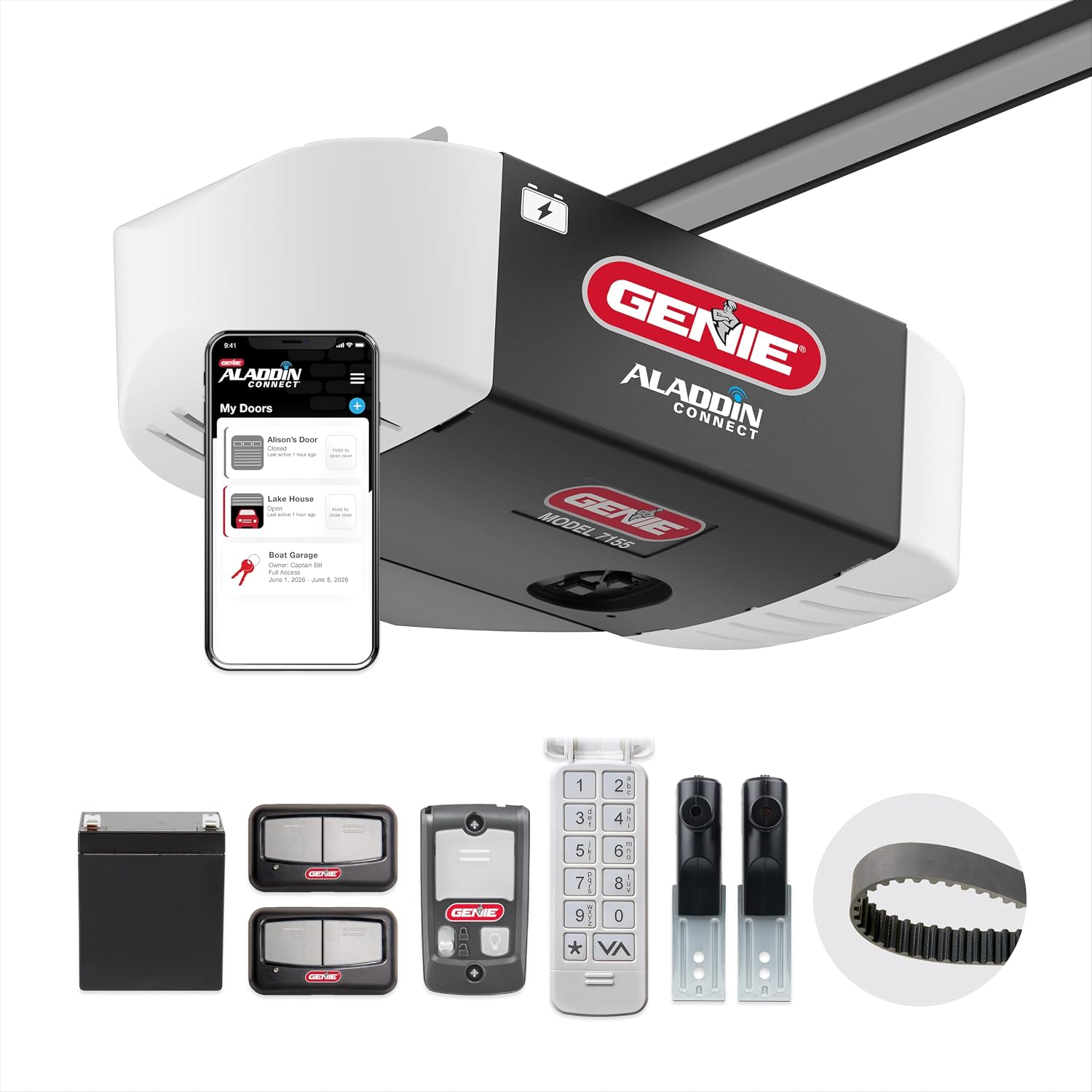
So here is how I sort the four openers worth looking at right now: a belt drive for the house with a bedroom over the garage, a chain drive for the detached shop, a wall mount for tall doors, and a wall mount with battery backup for storm country.
Best Overall: Genie QuietLift Connect
If you have a bedroom above the garage, this is where I would put my money. Belt drive is the whole argument. A steel-reinforced belt has no links to slap against the rail, so the opener becomes a hum instead of a clatter, and the difference between this and a chain drive is the difference between your kid sleeping through a 6 a.m. departure and not. I have pulled belts out of openers that outlasted two motors, and I have never once recommended chain to somebody sleeping twenty feet from the rail.
The 3/4 HPC motor is the right size for a standard two-car door. It is not a big motor by commercial standards, and it does not need to be. On a balanced door, a motor in this class coasts. On an unbalanced door, no motor in this price range survives, which is why I check door balance before I check anything else.
The smart side is Alexa and Google Assistant compatibility and Wi-Fi built in, plus a wireless keypad in the box. That last part matters more than people think. A keypad is the thing you actually use when you walk the dog or come back from a run without the remote, and buying one separately is an easy $30 to $40 you did not budget for. Having it included means the outside entry works on day one.
The parts availability is the quiet advantage. When a gear or a photo-eye or a remote dies in year six, I want to be able to order it that week, not wait three weeks on a slow boat. Genie and Chamberlain are the two names where that is reliably true.
Best Value: Genie Chain Drive 500
This is the opener I recommend when the garage is detached, or when the door is under a room nobody sleeps in. Chain drive is loud, and I am not going to pretend otherwise. The chain slaps the rail on the way up and it slaps on the way down. In a detached shop or a garage under a kitchen, that noise is a non-issue.
The 1/2 HPC motor is the smallest in this group, which is not a defect, it is a spec. It wants a door that is balanced and a rail that is dead straight. If your door is heavy, or if the springs are tired, this is the wrong opener and the belt drive above is the right one. If your door is a standard single or a well-adjusted double, it does the job.
The smart features are the same family as the QuietLift: Wi-Fi, app control, and voice assistant compatibility. The thing I care about on a budget unit is not the app, it is whether the travel limits hold after a power outage. Openers that forget their limits after a brownout are the single most common service call I get, and it is almost always the cheap ones that forget. Set the limits carefully, run the door through a full cycle three times, and then trip the breaker and check it again. If it comes back where it started, keep it. If it drifts, send it back while the return window is open.
Best for Tall Doors: Genie B6172H Wall Mount
A wall mount opener is a different animal, and it solves a problem the ceiling-mounted units cannot. It mounts on the side of the door at the jackshaft instead of hanging from the ceiling, which means no rail running down the middle of your garage and no motor hanging over the car. If you have a high-lift door, a shop with a lift in it, or a garage you actually want to use, that open ceiling space is worth real money.
This one is built for the tall stuff: doors up to 14 feet high and up to 850 pounds, with a DC motor. The DC motor is the detail I like. DC motors in this class start softer and hold their speed better than the AC motors in budget units, which is easier on the gears and easier on the door hardware.
The trade-off is that a wall mount opener needs a torsion bar to mount to. If your door uses extension springs, or if you have never looked up at the shaft above the door, go look before you order. This is not a spring job you want to take on yourself, and I will say that plainly: torsion springs are lethal, call a pro. But once the door has a torsion shaft and the springs are right, this is the cleanest install in the category.
Best When the Power Goes Out: Chamberlain Wall Mount myQ with Battery Backup
In Tulsa, battery backup is not a luxury feature, it is the feature. When an ice storm takes the grid down, the garage door is how you get the car out, and a dead opener turns a bad night into a worse one. Every storm season I get calls from people who had to pull the emergency release cord and muscle a two-car door up by hand in the dark.
This one is a wall mount like the Genie above, so it keeps the ceiling clear, and it adds a battery that keeps the door working when the house is dark. It also runs on the myQ platform, which is the same ecosystem Chamberlain and LiftMaster have been building for years, so remotes, keypads, and accessories are easy to find locally.
The honest caveat about any battery backup is the battery itself. Lead-acid packs cook in a hot garage, and a garage in July is a hot garage. My current focus is exactly this: whether the packs in these units survive a Tulsa summer. If you buy one, test it on purpose. Kill the breaker, run the door, and see how it behaves while the failure is your idea instead of the weather's idea. Do that twice a year and you will never be surprised.
What I Check Before I Recommend Any Opener
The motor is the least important part of the machine, so I look past it. Here is the order I actually use.
Door balance first. Disconnect the opener and lift the door halfway by hand. If it does not stay there, the springs are wrong, and no opener will last. This is the prerequisite for every recommendation on this page.
Gear material. Plastic gears in a unit marketed as heavy duty is the fastest way to lose my interest. I have a drawer full of them with failure dates on the label.
Safety reverse and the photo-eye. The door has to reverse when it meets an obstruction, and the photo-eye has to hold its alignment. Photo-eyes that need realignment after every bump are a pet peeve of mine, usually because the brackets are flimsy.
Travel limits that hold. Power goes out here constantly. An opener that forgets its limits after an outage is a service call waiting to happen.
Parts availability. The cheap brands are fine until something breaks, and then you wait three weeks for a part. Chamberlain and LiftMaster own the market for a reason.
App pairing. Smart features are 10 percent of the product and 90 percent of the support calls. I have reset more Wi-Fi modules than motors. If the app will not pair in fifteen minutes, the problem is usually the router, not the opener.
The Opener Comparison Table
| Opener | Drive | Best for | Backup | Price |
|---|---|---|---|---|
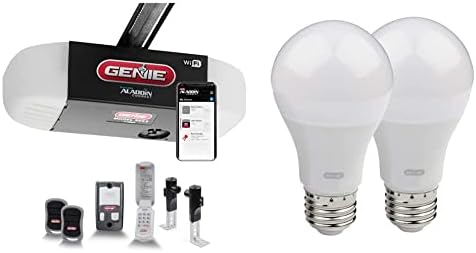 Visit on Amazon → Genie QuietLift Connect, belt drive, Wi-Fi, keypad included |
Belt, 3/4 HPC | Bedroom above the garage | No | $259.61 |
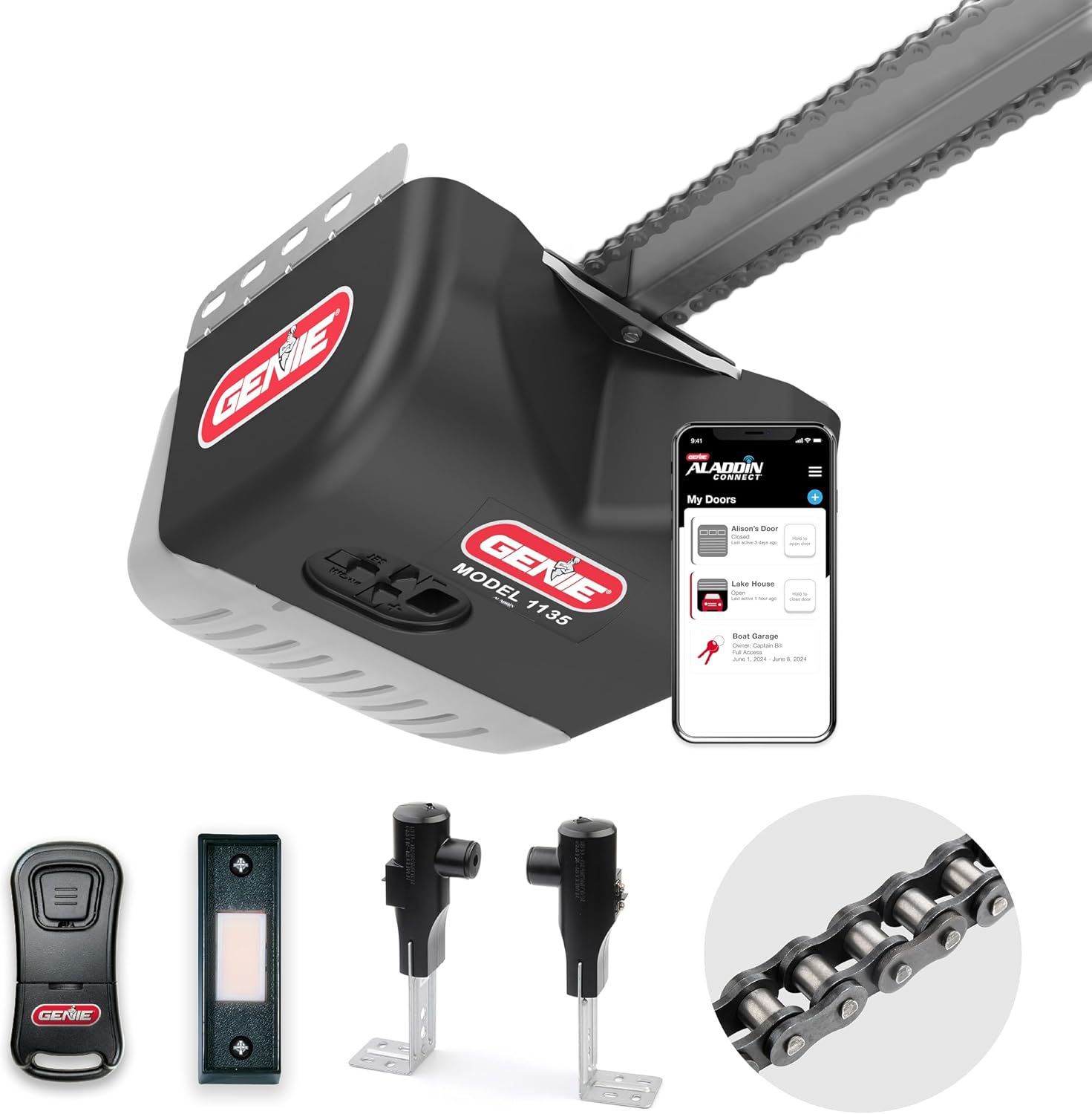 Visit on Amazon → Genie Chain Drive 500, chain drive, smart |
Chain, 1/2 HPC | Detached garage, tight budget | No | Check current Amazon price |
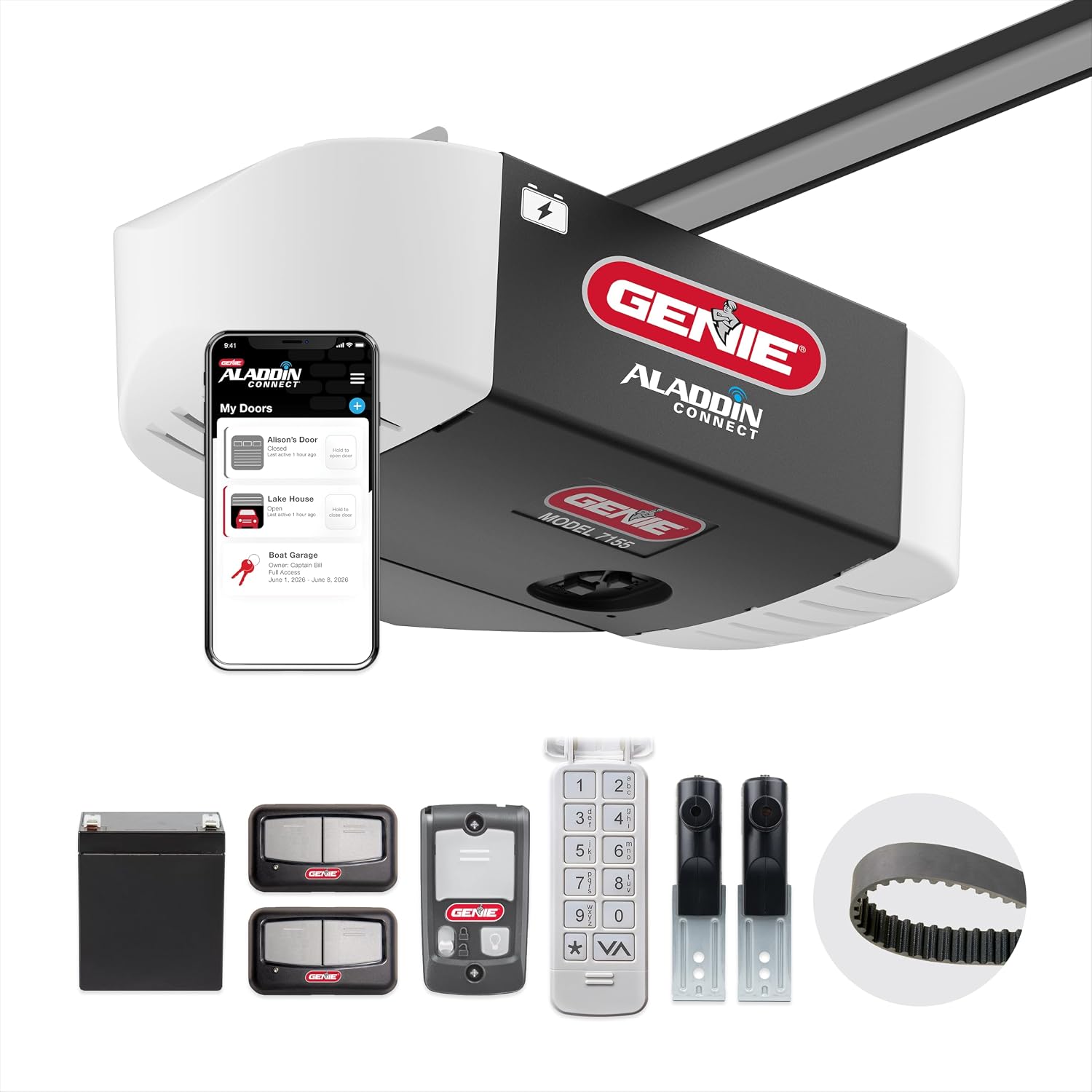 Visit on Amazon → Genie B6172H wall mount, DC motor, up to 14 ft and 850 lbs |
Wall mount, DC motor | Tall doors, clear ceiling | No | $554.21 |
 Visit on Amazon → Chamberlain wall mount, myQ, battery backup |
Wall mount, DC motor | Storm country, tall doors | Yes | $519.00 |
Belt Drive, Chain Drive, and the Wall Mount Question
Belt drive is quieter and it lasts as long as chain. That is the short version. The only reasons to buy chain are a tight budget or a detached garage where nobody is trying to sleep. The price gap between the two is small enough now that I expect belt to take over the whole category at every price point within a few years.
Wall mount is a different decision, and it is about your door, not your budget. If you have a torsion bar and a tall door, a wall mount gets the hardware out of the middle of the ceiling and gives you back the space. If you have extension springs, you are looking at ceiling mount, full stop.
Where people get burned is installation. I charge $150 to $250 for an install, and I have seen enough DIY jobs to tell you that about 80 percent of them have the rail wrong, the header bracket in the wrong place, or the door never balanced afterward. The install is doable if you are handy and you have a second person for the rail and the header. If you are not, pay somebody, and pay somebody who will balance the door while they are there. That is the part that decides whether the opener lasts five years or fifteen.
Should you buy the Genie QuietLift Connect?
If there is a bedroom above your garage, yes. Belt drive, a 3/4 HPC motor, Wi-Fi, and a keypad in the box is the combination I want in a house where people sleep. Balance the door first, set the travel limits carefully, and this is the one I would put on my own house.
Should you buy the Genie Chain Drive 500?
Yes, with conditions. Detached garage or nobody sleeping above it, and a door that is already balanced and light. It is the budget pick and it behaves like one. If you can spend more, the belt drive is worth the difference.
Should you buy the wall mount openers?
If you have a torsion bar, yes. The Genie B6172H is the pick for a tall or heavy door, up to 14 feet and 850 pounds, and the Chamberlain myQ unit is the pick when you want the door to keep working in a storm. Check the shaft above your door before you order, and call a pro for anything involving the springs.