Most people shop for a garage door opener the way they shop for a ceiling fan: pick a horsepower number, pick a familiar brand, and call it done. Then the opener spends the next eight years quietly explaining what they got wrong. I have pulled more than 200 openers out of Tulsa garages, and the failures cluster in predictable places. Stripped plastic gears. Rails that were never straight. Photo-eyes that drift out of alignment every time somebody bumps the track. Doors that were never balanced in the first place, so the opener was lifting more weight than it was ever rated for. The motor is the least interesting part of the whole assembly. If you want a belt drive garage door opener to live a long life, start with the door, then match the drive type and the lifting power to it, and only then start caring about the phone app.
Related: How to Balance a Garage Door Before You Install an Opener →
Quick answer
For an attached garage with a bedroom above it, a belt drive opener with a steel-reinforced belt and lifting power in the 3/4 HP class is the sensible default. A wall-mounted unit is the better answer when you need the ceiling back for storage, or when headroom is tight. Match the lifting power to the door's weight and height, verify that the door is balanced and that its safety reverse and photo-eye both work, and treat smartphone control as a convenience layer rather than a reason to buy. Drive type and door condition decide whether the opener lasts five years or fifteen.
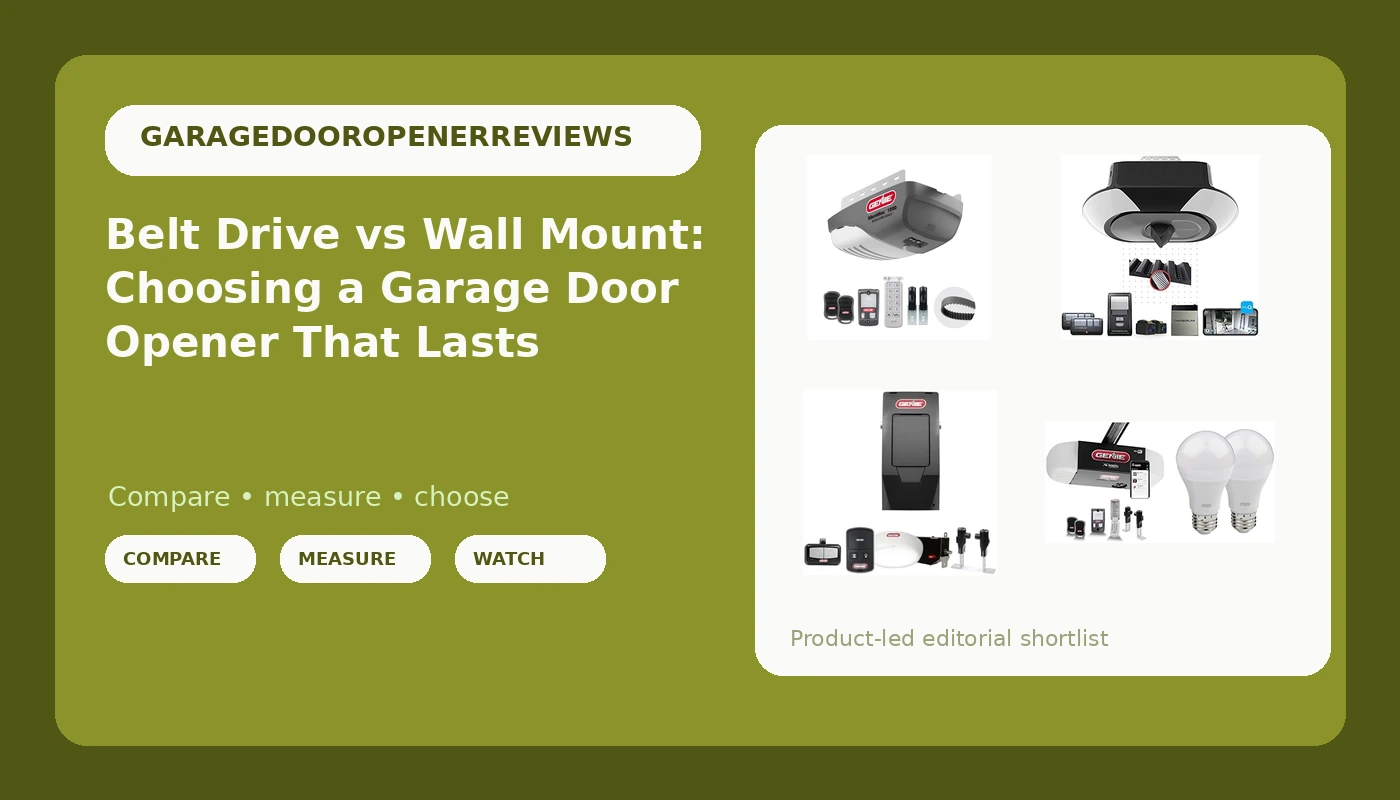
Four useful options
| Model | Best fit | What stands out |
|---|---|---|
| Genie SilentMax 1200 Model 4042-TKH Garage Door Opener | Attached garage under a bedroom | Steel-reinforced belt drive, 140V DC motor, motion detection lighting |
| Chamberlain B6753T Smart Garage Door Opener | Households that want camera and app control | myQ smartphone control, video streaming, advanced corner LED lighting |
| Genie 6072H-O Residential Wall Mounted Garage Door Opener | Garages where the ceiling is already in use | Wall-mounted design that keeps the overhead space clear |
| Genie QuietLift Connect Smart Garage Door Opener Bundle | First-time smart opener buyers | Bundle includes LED light bulbs and a keypad |
The bedroom-above-garage pick: Genie SilentMax 1200 Model 4042-TKH Garage Door Opener
This is the shape most attached-garage homes should be shopping. A steel-reinforced belt does not slap against the rail the way a chain does, which matters when there is a bed directly above the door. The trade-off is cost and a little more care during install: belts want a straight rail and correct travel limits, and if the rail sags or the door is out of balance, a belt will let you know before a chain would. The motion detection lighting is a genuinely useful extra in a garage you walk into with your hands full, and it is the kind of feature that costs nothing to maintain.
The connected pick: Chamberlain B6753T Smart Garage Door Opener
Chamberlain and LiftMaster own the residential market for a reason that has nothing to do with marketing: parts availability. When a gear or a logic board fails six years in, you can usually find the part instead of waiting three weeks on a slow boat. The trade-off here is complexity. Video streaming and app pairing are the features most likely to generate a support call, and the ones most likely to be abandoned after a year. If you want the camera and the app, buy it deliberately. If you mainly want a quiet belt drive, you are paying for hardware you will not use.
The ceiling-space pick: Genie 6072H-O Residential Wall Mounted Garage Door Opener
Wall-mounted openers are the answer to a problem most buyers do not discover until install day: the rail and the power head have to live somewhere, and that somewhere is the ceiling space you wanted for bikes, a kayak, or a hoist. Mounting on the wall beside the door clears all of it. The trade-offs are real, though. Wall-mount units generally pair with torsion-spring doors rather than extension springs, they need a specific side clearance at the door jamb, and the install is a different job than hanging a rail. Check compatibility before you buy, not after.
The bundle pick: Genie QuietLift Connect Smart Garage Door Opener Bundle
Bundles save you a second order and a second shipping wait, and the LED bulbs and keypad are the two accessories almost everybody ends up buying anyway. The honest caveat is that the listing does not state the drive type. QuietLift is Genie's quieter line, but quiet can mean a belt or a well-isolated chain, and those are different products for a bedroom-above-garage house. Confirm the drive type and the lifting rating before you commit. If it comes back as a belt drive in the right lifting class, this is an efficient way to get a smart opener and the accessories in one purchase.
Prices and availability may change. Product images, names, and retailer links are matched to verified listings. No current price, rating, stock status, or measured result is stated here without current evidence.
What door balance does to an opener
A garage door is a counterweight system, not a dead weight. Springs are supposed to carry most of the door, and the opener is supposed to lift the small remainder. When the door is balanced, it will sit still at the halfway point with the opener disconnected. When it is not, the opener hauls the full weight of the door every single cycle, and everything downstream suffers: gears wear, belts stretch, travel limits drift, and the safety reverse starts behaving inconsistently because the opener is fighting a load it was never sized for.
Before you shop, disconnect the opener with the release cord, lift the door to about waist height, and let go. A balanced door stays put or drifts gently. A door that slams down or floats up is out of balance, and no opener on this list will fix that. Adjusting springs is the one job I tell every homeowner to hand to a professional. A torsion spring under load carries enough stored energy to break bones, and it is not a DIY project no matter what a video tells you.
How to compare these four in five steps
- Weigh the door and measure its height. A standard seven-foot door is well served by the 3/4 HP class. A heavy insulated eight-foot door pushes you toward the higher lifting ratings, which is where the Chamberlain unit sits.
- Check the headroom and what the ceiling is doing. If you store anything overhead or plan a lift, the wall-mounted Genie belongs on your shortlist and the rail-hung models do not.
- Decide belt or chain before you decide brand. For a bedroom above the garage, belt drive is worth the modest premium. Chain makes sense for a detached shop or a hard budget, where noise does not matter.
- Decide how much smart you actually want. If you will use the camera and app, the Chamberlain earns its place. If you have watched a neighbor fight a cloud login to open their own door, buy for the hardware and treat the app as a bonus.
- Confirm the boring things: safety reverse, photo-eye alignment, an outlet near the power head, and parts availability for the brand. These decide how the next decade goes far more than the app does.
Before you buy: what to measure and check
- Run the balance test with the opener disconnected, and call a pro if the door fails it.
- Measure door height, width, and the ceiling clearance above the highest door panel.
- Verify there is a working outlet within reach of the power head, and check whether the ceiling above the door is clear of ducts and plumbing.
- Test the safety reverse and the photo-eye, and plan on re-aiming the photo-eye if sunlight hits it in the late afternoon.
- Decide whether you want battery backup. In tornado country, a garage door that opens when the grid is down is an emergency exit, not a luxury.
Which option should you choose?
Choose the Genie SilentMax 1200 Model 4042-TKH Garage Door Opener when you have a bedroom above the garage and want a steel-reinforced belt drive with motion lighting and no app to maintain. Choose the Chamberlain B6753T Smart Garage Door Opener when you want camera coverage, smartphone control, and the strongest lifting rating in this group, and you are willing to manage the app. Choose the Genie 6072H-O Residential Wall Mounted Garage Door Opener when ceiling space matters more than anything else and your door is compatible with a wall-mount install. Choose the Genie QuietLift Connect Smart Garage Door Opener Bundle when you want a smart opener with the keypad and bulbs included, after you confirm which drive type you are getting.
One caveat worth stating plainly: the listings here describe features, not performance in your garage. Lifting power, noise, and long-term reliability all depend on door weight, spring condition, rail alignment, and how well the install was done. A well-installed mid-range belt drive on a balanced door will outlast a premium unit bolted to a door that was never adjusted.
The bottom line
Drive type and door condition decide whether your opener lasts five years or fifteen, and the motor barely enters into it. Balance the door first, measure your headroom, then buy for the drive you actually need: belt drive for a house with a bedroom over the garage, wall mount when the ceiling is spoken for, and the connected model when you genuinely want the camera and the app. Smart features are a small part of the product and a large part of the support calls, so buy the hardware first and let the app be a bonus. Check current Amazon price on the model that matches your door, and spend the saved money on a straight rail and a proper install.