Most homeowners start shopping for a garage door opener by comparing horsepower, and horsepower is the least useful number on the box. The motor is rarely what fails. What fails is the rail that was never aligned, the door that was never balanced, the photo-eye that got bumped by a trash can, and the plastic gear set inside a unit advertised as heavy duty. A belt drive garage door opener solves one real problem, noise, and it does nothing for the other four.
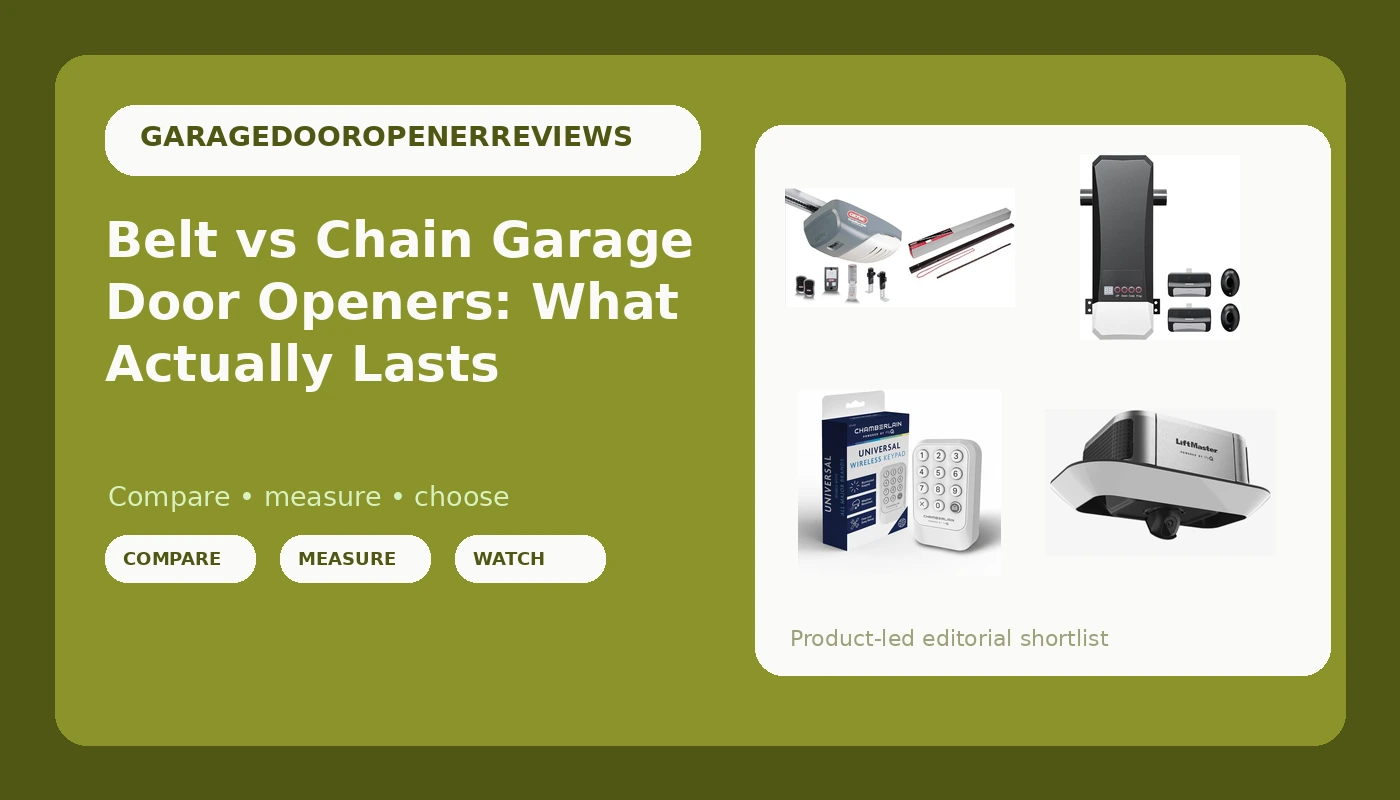
So this is not a horsepower contest. It is a look at four pieces of hardware that cover four different jobs: a flagship belt drive unit with battery backup and a camera, a chain drive value option that ships with a rail extension, a wall-mounted opener for garages where the ceiling is already spoken for, and a wireless keypad that fixes the most common access complaint in any household. Here is how they differ, what the listings actually promise, and which one fits your garage.
Related: Belt vs Chain Garage Door Openers: Noise, Cost, and Lifespan →
Quick answer
Match the drive type to what sits above the garage. If a bedroom is over the garage, buy belt drive, because the noise difference is real and permanent. If the garage is detached and nobody sleeps near it, chain drive costs less and holds up fine. Battery backup is worth paying for in storm country, where the door is an exit, not a convenience. Balance the door before you install anything, because an unbalanced door wears out openers of every brand.
Four useful options
| Model | Best fit | What stands out |
|---|---|---|
| LiftMaster 6690L Smart Garage Door Opener | A bedroom above the garage and one app for the whole house | 1-1/4 HP belt drive with a built-in camera, LED lighting, battery backup, and myQ |
| Genie ChainMax 1000 Garage Door Opener | A detached garage or a tight budget | Chain drive with two 3-button remotes and an EKTC extension kit for 8-foot rails |
| ZUMI Automatic Garage Door Opener | Garages with no ceiling room to spare | Wall-mounted design with manual backup and infrared sensors |
| Chamberlain Genuine Universal myQ Wireless Garage Door Keypad | Anyone who keeps losing remotes | Wireless keypad that adds a code entry point to a myQ system |
The full-featured flagship: LiftMaster 6690L Smart Garage Door Opener
This is the one to look at if you want the whole feature set in a single box and you are not interested in piecing it together. The trade-offs are the obvious ones. It carries the highest ticket of the four, and when you buy at the top of a brand's line you are paying partly for the badge and partly for the app polish. The camera is a genuine convenience, not a substitute for a real security camera, so treat it as a look at the driveway rather than a monitored system. If the power goes out in an ice storm, battery backup is the feature you will actually notice, and it is built in here instead of bolted on afterward.
The value chain drive: Genie ChainMax 1000 Garage Door Opener
Chain drive gets dismissed as the loud option, and it is louder. What people miss is that chain is also the drive that tolerates neglect and cold. The extension kit matters more than most buyers realize: an 8-foot door needs a longer rail than a standard 7-foot door, and buying the kit separately after the fact is the kind of mistake that turns a Saturday install into a two-week project. Check your door height before you order. If the garage is detached, or if the door is under a room nobody uses, the noise argument mostly disappears and the savings are real.
The wall-mounted option: ZUMI Automatic Garage Door Opener
Wall-mount units are the answer for a garage with a low ceiling, a storage rack, or a car lift, and they are the wrong answer for a lot of other garages. They couple to the torsion shaft, so the door needs the right spring setup and the right side clearance for the unit to sit next to the track. If your door runs extension springs, this is not a weekend swap, and spring work is the one job on a garage door that I will not talk a homeowner through. The manual backup here is a hand-crank style convenience for power outages, not a battery system, so read that difference carefully if outage access is the reason you are shopping.
The add-on access point: Chamberlain Genuine Universal myQ Wireless Garage Door Keypad
Keypads are the most underrated accessory in this category. Remotes die in a hot visor, they get lost in truck consoles, and every household eventually has one car with no remote in it. A keypad solves that permanently. The one thing to verify before ordering is compatibility: this is a myQ keypad, so it belongs on a myQ-connected opener, and pairing it to an older or non-myQ unit is not a given. If you are already running a Chamberlain or LiftMaster opener with myQ, this is close to a plug-and-play addition.
Prices and availability may change. Product images, names, and retailer links are matched to verified listings. No current price, rating, stock status, or measured result is stated here without current evidence.
Belt drive versus chain drive: where the noise really comes from
The drive is only one part of the noise. When a door rumbles through the house, the sound is a mix of the motor, the rail, the trolley, the rollers in the track, and the door panels themselves. A belt drive opener removes the metallic chain slap from that list, and it is the single change that helps most when a bedroom sits over the garage. It does not silence a door with worn steel rollers, and it does not help at all if the rail is bolted in crooked.
The other variable people ignore is the door itself. A door that is out of balance forces the opener to drag weight it was never meant to carry, which is what strips gears and burns out motors. Balance the door by hand with the opener disconnected before you install anything. If it will not stay halfway up on its own, the opener is the wrong purchase and a spring adjustment is the right one.
Battery backup deserves its own note. In a region with ice storms and tornado warnings, the garage door is often the largest opening in the house and the fastest way to move a car out. Battery backup keeps that door working when the grid does not. The catch, and it is a real one, is that garage heat shortens battery life, so a backup unit that sits in a 120-degree garage in August will need its battery replaced on a schedule, not on a whim.
How to size an opener to your door
- Measure the door height and width, and note whether you have a single door, a double door, or two singles.
- Identify the spring type and check the door balance by hand with the opener disconnected.
- Confirm the ceiling height, headroom, and whether a wall-mounted unit has clearance beside the track.
- Pick the drive type based on what is above the garage, then pick the rail length or extension kit to match the door.
- Verify the safety reverse and the photo-eye alignment after installation, and test both every month.
What to check before you buy
- Door height first, because an 8-foot door needs the longer rail or extension kit.
- Headroom and side clearance, because wall-mounted openers need room next to the torsion shaft.
- Spring type, because extension springs and torsion springs lead to different install plans.
- Outage needs, because a hand-crank manual release and a rechargeable battery backup are not the same feature.
- Ecosystem, because a myQ keypad belongs with a myQ opener and pairing is not universal.
- Remote count, because a two-car household needs two remotes or one keypad it can share.
Which option should you choose?
Choose the LiftMaster 6690L Smart Garage Door Opener when a bedroom sits above the garage, you want battery backup for storm season, and you would rather have the camera, lighting, and app in one purchase. Choose the Genie ChainMax 1000 Garage Door Opener when the garage is detached or noise is not a factor and you want the chain drive plus the 8-foot rail extension in the same box. Choose the ZUMI Automatic Garage Door Opener when ceiling space is the limiting factor and the door has the right spring and side clearance for a wall-mounted unit. Add the Chamberlain Genuine Universal myQ Wireless Garage Door Keypad when the real problem is access, not the opener.
One caveat on all four: the distinctions above come from the manufacturer listings, not from measured side-by-side testing, and I have not run any of these units in my own garage. Treat the feature lists as a starting point and confirm the specs against your door before you order.
The bottom line
The opener is the cheapest part of this decision and the easiest to replace. The door, the springs, the rail alignment, and the safety system are what determine whether the unit you buy lasts five years or fifteen. Buy belt drive if people sleep above the garage, buy chain if they do not, pay for battery backup if your power goes out, and add a keypad so nobody is locked out when a remote dies in the heat. Get the door balanced first. Everything else on this list is a detail compared to that.