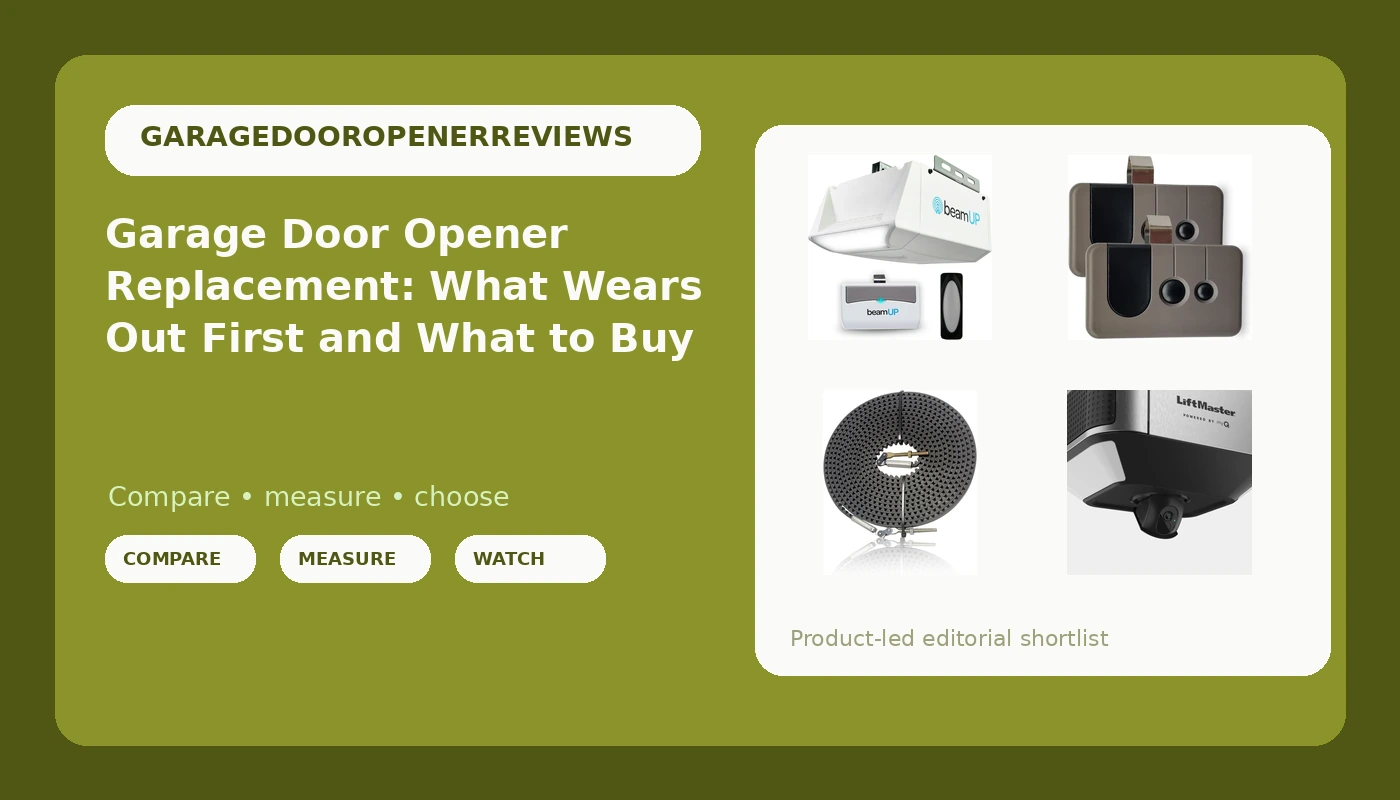
Most garage door opener replacement decisions start in the wrong place. A door that stalls halfway up, reverses for no reason, or refuses to close usually has a worn belt, a misaligned rail, a dead remote, or a door that is out of balance, and a new motor will not fix any of those. The motor is the least important part of the system. What decides whether your next opener lasts five years or fifteen is the drivetrain, the rail geometry, the condition of the door, and how easy it is to find parts when something finally fails. This guide walks through the four options worth considering for a garage door opener replacement, from a full belt drive unit with battery backup down to a single replacement belt, and explains how to tell which one your situation actually calls for.
Related: Belt Drive vs Chain Drive Garage Door Openers: Noise, Cost, and Longevity →
Quick answer
Buy a complete opener only when the motor or the logic board has failed. When the door still runs and only one component has quit, buy the component. For a full replacement, a belt drive unit is the right target for a house with a bedroom above the garage, and a chain drive unit is the budget path when the garage is detached and nobody sleeps near it. Before ordering anything, confirm the three details that govern fit: the color of the learn button on the existing opener, the height of the door, and whether the new unit is listed as compatible with the model it replaces.
4 useful options
| Model | Best fit | What stands out |
|---|---|---|
| Liftmaster 6580L Belt Drive Motor Battery Backup with Integrated Security Camera (Replaces 84505, 84504) Plus Two Free Ace Stickers | A house that needs a complete new opener with backup power and a camera | Belt drive motor, battery backup, integrated security camera, listed as a replacement for 84505 and 84504 |
| Pacer BU50 Overhead Garage Door Opener with Heavy-Duty Chain Drive for Single or Double Doors, Wall Mount, and Remote Garage Opener Included, Quick and Easy Installation, White | A detached garage, a rental, or a tight budget | Chain drive, listed for single or double doors, wall mount design, remote opener included |
| Garage Door Opener Remotes for All Sears Craftsman Chamberlain Liftmaster Garage Door Opener with Yellow Learn Button 2 Pack | A working opener whose remote has died | Two remotes in the pack, listed for openers that use a yellow learn button |
| 39354R.S Belt Compatible with Genie Garage Door Opener Fit 7 Ft Door | A Genie opener that needs a fresh belt | Belt listed as compatible with Genie openers and sized to fit a 7 ft door |
The full-system upgrade: Liftmaster 6580L Belt Drive Motor Battery Backup with Integrated Security Camera (Replaces 84505, 84504) Plus Two Free Ace Stickers
This is the option that covers the whole job at once, and it is the one to weigh when the existing opener is dead rather than merely annoying. Belt drive is the drivetrain I recommend to anyone with living space over the garage, because the belt removes the chain slap that transmits straight through the ceiling. Battery backup matters more than most buyers expect. In tornado country, a garage door that still opens when the grid is down is the difference between driving out and waiting. The trade-offs are honest ones. This is the most expensive path in this group, the camera means a Wi-Fi module and an app in the loop, and a battery pack living in a hot garage is the component most likely to age faster than the motor. The listing also points at specific models it replaces, so check that your current unit is on that list before you commit.
The budget opener: Pacer BU50 Overhead Garage Door Opener with Heavy-Duty Chain Drive for Single or Double Doors, Wall Mount, and Remote Garage Opener Included, Quick and Easy Installation, White
Chain drive is not a compromise for every house. If the garage is detached, or the space above it is storage rather than a bedroom, the noise argument disappears and you keep the money. What I would check before ordering is the hardware inside the unit, not the phrase on the box. "Heavy-duty" is a marketing word, and plenty of openers that carry it have shipped with plastic drive gears that strip under a door that was never balanced. The listing here also promises quick installation, and the install is where most of the disappointment lives: the rail has to be level, the travel limits have to be set, and the safety reverse has to be verified. A chain unit installed on a badly aligned rail will fail long before the chain does.
The replacement remote: Garage Door Opener Remotes for All Sears Craftsman Chamberlain Liftmaster Garage Door Opener with Yellow Learn Button 2 Pack
Remotes die quietly. They live in a visor where summer heat bakes them, the buttons wear through, and eventually the door stops responding while the wall control still works fine. That pattern points at the remote, not the opener, and it is the cheapest thing on this list to fix. The one step you cannot skip is the button check. Compatibility here is tied to a yellow learn button on the opener head, and openers with a different color button use a different radio. Look at the back of the existing opener, find the learn button, and confirm the color before you order. Programming is a press-and-hold routine on the opener head followed by the remote, and it takes a few minutes once you have the right part in hand.
The maintenance part: 39354R.S Belt Compatible with Genie Garage Door Opener Fit 7 Ft Door
A belt is a wear item, and replacing one is far cheaper than replacing an opener that still runs. The two numbers that decide fit are the brand and the door height. This belt is listed for Genie openers and for a 7 ft door, which covers the standard residential height, but a taller door takes a longer belt and an 8 ft door will not work with a 7 ft part. When a belt is the actual failure, the symptom is usually a door that moves unevenly, sags on one side, or slips under load while the motor keeps running. If instead you hear grinding, the problem is more likely in the drive gear or the rail, and a new belt will not cure it.
Prices and availability may change. Product images, names, and retailer links are matched to verified listings. No current price, rating, stock status, or measured result is stated here without current evidence.
What actually fails first
Openers get blamed for problems that start elsewhere. The most common failure in a residential system is not the motor at all. It is the door. A door that is out of balance puts its full weight on the opener for the entire travel, and that load strips gears, stretches belts, and burns out motors that were perfectly adequate. The balance test is simple: disconnect the opener from the door with the release cord, lift the door to about waist height, and let go. A balanced door stays where you put it. A door that slides down on its own is telling you the springs or the track need attention, and no new opener will survive long on top of that.
The second most common failure is alignment. A rail that is not level, a trolley that binds, or a track with a bent section will cause the opener to work harder on every cycle. After that come the small parts: photo-eyes that lose alignment after a bump and refuse to let the door close, travel limits that drift after a power outage, and remotes that cook in a hot car. Motors and logic boards do fail, and when they do, the replacement decision is real. Until then, most "dead opener" calls are a part problem with a part solution.
Belt drive, chain drive, and why the parts matter
Belt drive and chain drive move the same door with the same motor, and the difference is noise. A belt is a reinforced rubber strip that runs quietly and does not need lubrication. A chain is metal links that clatter against the rail and want occasional grease. For a garage under a bedroom, the belt is the obvious answer, and the price gap between the two has narrowed to the point where the noise argument usually wins. Chain still makes sense in a detached garage, a shop, or a rental where the budget matters more than the sound.
What separates a long-lived opener from a short-lived one is parts availability. A unit that works for eight years and then needs a gear kit is a better purchase than a cheaper unit that works for five and becomes disposable because nothing fits it. That is why the brand question matters less than the support question, and why a full unit with a documented replacement path is easier to live with than an off-brand box with no parts channel.
Five steps decide which of these options fits your garage:
- Disconnect the opener and test the door balance. If the door will not stay put, fix the door before you buy anything.
- Identify what actually failed. A silent motor is a unit problem. A dead remote, a slipping belt, or a misaligned photo-eye is a part problem.
- Match the part to the existing hardware. Check the learn button color for remotes, the door height for belts, and the listed replacement models for a full unit.
- Choose the drivetrain based on where people sleep. Belt for an attached garage with living space above, chain for a detached structure where noise does not travel.
- Treat battery backup and smart features as the last decision, not the first. Buy them after the drivetrain and the parts channel are settled.
Practical guidance before you order
- Balance and lubricate the door first. Rollers, hinges, and the track take a light lubricant, and a freely moving door is the cheapest upgrade your system will ever get.
- Look at the learn button on the opener head before ordering remotes. The yellow button units and the other colors are not interchangeable.
- Measure the door height before ordering a belt. A 7 ft belt is the common size, but a taller door needs a longer one.
- Replace the whole opener when the motor or logic board is gone, and replace the part when only one component failed. The motor is rarely the piece that quit.
- Leave the springs alone. Torsion and extension springs are under lethal tension, and a spring replacement is a call to a professional, not a weekend project.
Which option should you choose?
Choose the Liftmaster 6580L Belt Drive Motor Battery Backup with Integrated Security Camera (Replaces 84505, 84504) Plus Two Free Ace Stickers when the existing opener has failed outright and you want a belt drive unit with backup power, a camera, and a documented replacement path for the 84505 and 84504. Choose the Pacer BU50 Overhead Garage Door Opener with Heavy-Duty Chain Drive for Single or Double Doors, Wall Mount, and Remote Garage Opener Included, Quick and Easy Installation, White when the garage is detached, the budget is the deciding factor, and chain noise will not bother anyone. Choose the Garage Door Opener Remotes for All Sears Craftsman Chamberlain Liftmaster Garage Door Opener with Yellow Learn Button 2 Pack when the opener itself still works and only the remote has quit. Choose the 39354R.S Belt Compatible with Genie Garage Door Opener Fit 7 Ft Door when a Genie opener on a 7 ft door has a worn belt and the rest of the unit is healthy.
The caveat that applies to all four: fit is decided by details that live on your existing hardware, not on the product page. Button color, door height, and the model the new unit is listed to replace are the three things that turn a good purchase into a return. Confirm them before checkout, and treat any listing claim about durability as a claim rather than a measurement.
The bottom line
The best garage door opener replacement is the smallest one that solves your actual problem. If the door still runs and only a remote, a belt, or a sensor has failed, buy that part and keep the motor you already own. If the unit is genuinely dead, a belt drive with battery backup is the sensible target for an attached garage with living space above it, and a chain drive unit is a defensible choice for a detached structure where noise never reaches a pillow. Either way, balance the door first, check the compatibility details second, and expect the installation to matter more than the badge on the box.