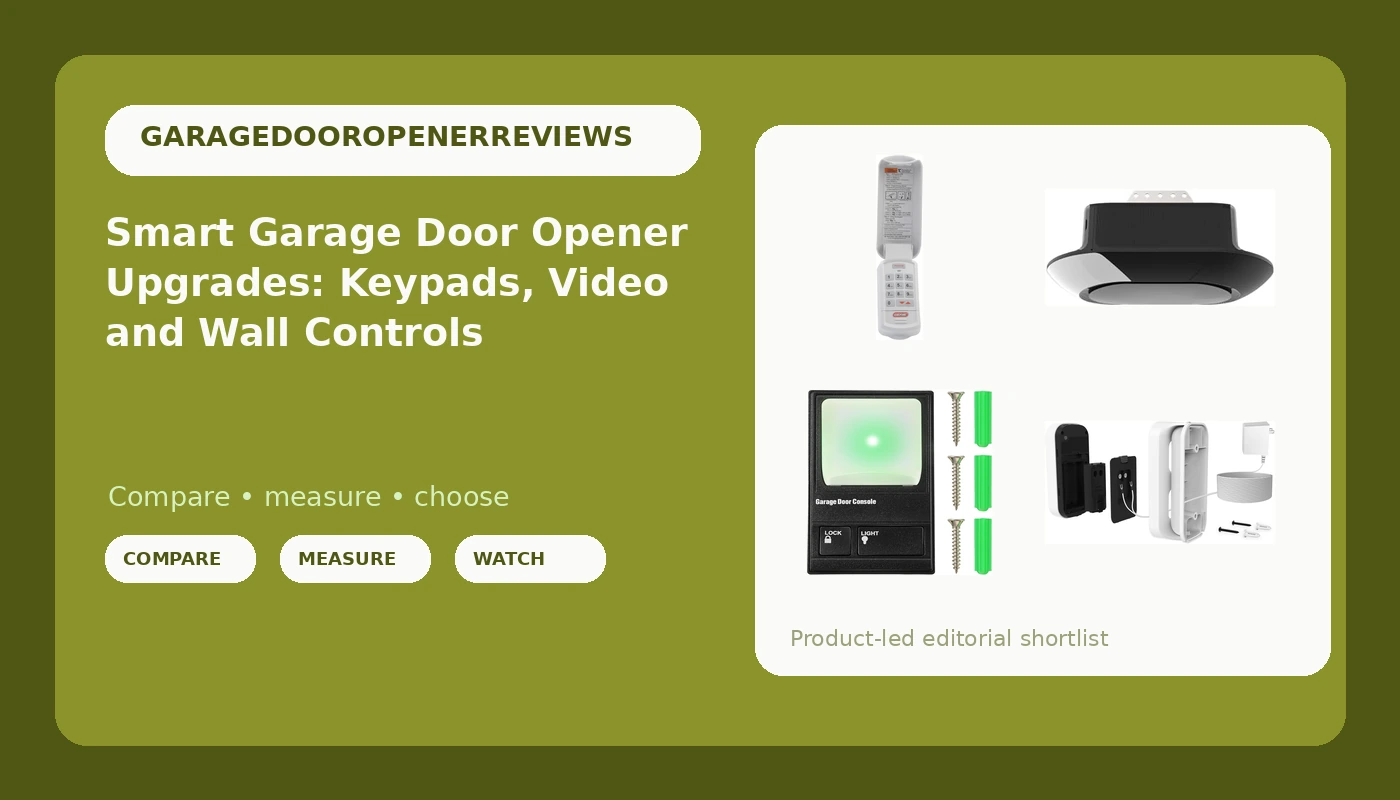
Most people who go shopping for smart garage door opener upgrades start with the wrong question. They open a listing page, see motors, keypads, adapters, and wall consoles mixed together, and assume the newest opener is the answer. Then the box arrives, the door still shudders on the way up, and the app that was supposed to simplify things wants a cloud login before it will lift the door in the driveway.
The useful way to shop is to split the job in two. What is actually moving the door, and what stands between you and getting in? The four products below cover both halves: a complete belt-drive opener with battery backup, a video keypad that runs on wired power, a wireless PIN keypad, and a replacement wall console for an opener that is otherwise healthy.
Related: Belt Drive vs Chain Drive: Which One Survives a Cold Snap →
Quick answer
If the opener itself is on its way out, the belt-drive unit with battery backup is the only product here that replaces the thing that lifts the door. Everything else is an accessory for an opener that already works. If the door opens fine but entry is the annoyance, a keypad solves that without touching the opener, and a video keypad adds a camera view of the driveway on top of PIN entry. If a wall console has gone dead or its buttons no longer respond, the compatible replacement console is the smallest repair on this list. The deciding factor is not the brand or the app. It is whether the door is balanced, because a door that fights the opener will shorten the life of any motor you bolt to the ceiling.
Four useful options
| Model | Best fit | What stands out |
|---|---|---|
| Chamberlain B4613T MYQ Smart Garage Door Opener | Replacing an opener that has failed or is loud enough to hear upstairs | Belt drive, battery backup, and a 3/4-HP motor in one unit |
| myQ Smart Garage Door Video Keypad Wired Power Adapter Kit | Adding a camera and PIN entry at the driveway | Wired power instead of battery changes, listed for Chamberlain, LiftMaster, and Craftsman openers |
| Genie Garage Door Opener Wireless Keyless Keypad, Model GK-R | Simple PIN entry on a Genie Intellicode system | Wireless install, no wiring run to the door frame |
| Garage Door Opener Wall Mount Compatible with Liftmaster 41A5273-1 78LM | A failed or unresponsive wall console | Direct replacement control for the listed LiftMaster wall units |
The full replacement: Chamberlain B4613T
Buy this only when the opener is genuinely the problem. A belt-drive unit with battery backup makes the most sense in a house with a bedroom over the garage, and in storm country where the power goes out and the car is the way you leave. The trade-off is the install. A full opener means assembling a rail, setting travel limits, aligning the photo-eye, and getting the door balanced first. If the door is heavy on one side or the springs are tired, a new motor will simply wear out faster than the old one did. The motor is the least important part of this purchase. The rail, the belt, and the door balance decide whether the unit lasts five years or fifteen.
The video keypad: myQ Smart Garage Door Video Keypad Wired Power Adapter Kit
This is the accessory for someone who wants to see the driveway before opening the door, not just punch a code. It fits an opener that already works, which is why it belongs in a different conversation than a full replacement. The trade-off is the power run. A wired adapter has to reach the keypad location, so the mounting spot matters more than it does with a battery keypad. It also assumes your opener is one of the brands the listing names. If you have a Genie system, this is not the keypad for you.
The keyless entry keypad: Genie GK-R
This is the least complicated product on the page, and for a lot of households it is the only one they need. A keypad ends the problem of a remote dying in the visor heat or a spare remote disappearing. The trade-off is scope: it is listed for Genie Intellicode openers, so it is not a universal part, and it adds no camera and no app. That simplicity is also its strength. There is nothing to pair, nothing to log into, and nothing to reset after a power outage.
The wall console: LiftMaster-compatible wall mount
A wall console fails quietly. One day the light button does nothing, or the door will not close from the wall even though the remote still works. Owners often replace the whole opener at that point, which is like replacing a car because a door handle broke. Check the compatibility line carefully, because this part is matched to specific LiftMaster console numbers rather than sold as a universal fit. If your console matches, this is the cheapest path back to normal. If it does not, this product is not the answer.
Prices and availability may change. Product images, names, and retailer links are matched to verified listings. No current price, rating, stock status, or measured result is stated here without current evidence.
Why the motor is the last thing you should blame
Openers get replaced for problems the motor did not cause. A door that has drifted out of balance puts its full weight on the drive system, and the opener compensates by straining every cycle. That is why gears strip and rails flex. Before you spend anything, disconnect the opener from the door, using the emergency release, and lift the door by hand. A balanced door moves with light, steady effort and stays where you leave it halfway up. A door that drops or takes real muscle to raise needs attention before any new hardware goes on the ceiling.
Travel limits and photo-eye alignment come next. Travel limits set how far the opener pushes the door in each direction, and they drift. When they drift, the door either stops short or presses hard against the floor and reverses. The photo-eye, the pair of sensors at the bottom of the tracks, is the safety reverse system that stops the door if something crosses the beam. Sunlight hitting one sensor, or a bumped bracket, will make a healthy opener refuse to close. Both are adjustments, not replacements.
One boundary worth stating plainly: torsion springs, the wound springs above the door or on the shaft, store lethal energy. If a spring is broken, the door will feel impossibly heavy and may not stay up. Call a professional. Nothing in this article is spring advice, and no opener purchase fixes a broken spring.
What each accessory actually changes
The three accessories here solve three different problems, and mixing them up is how people end up with a product they cannot use.
A PIN keypad answers the question of who gets in without a remote. It is the right purchase when the opener is fine and the friction is daily entry. A video keypad answers that same question plus the one about who is standing in the driveway, and it asks for a wired power source in return. A wall console answers the question of how the door is controlled from inside the house, and it only applies when you have the matching opener.
Smart features deserve their own warning. They are a small slice of what an opener does and a large share of the support calls. Most of the frustration I see is not a dead motor, it is a homeowner who cannot get a phone to talk to a garage. Buy smart capability because you will actually use it, not because it is on the box.
How to decide, step by step
- Release the door from the opener and lift it by hand. If it is heavy or will not hold position, fix the door before buying anything.
- Check whether the existing opener runs at all. A motor that hums without moving, or a unit that has lost its limits repeatedly, points toward replacement.
- If the opener runs, list what actually annoys you: no remote-free entry, no view of the driveway, dead wall buttons. That list picks the accessory.
- Match compatibility before price. Keypads and consoles are brand and model specific, and a mismatch is a return.
- Plan the install. A full opener needs a rail assembly, limit settings, photo-eye alignment, and a helper for the head unit. An accessory needs a screwdriver and, for wired products, a power source.
Practical guidance
- Mount any exterior keypad at a comfortable height and out of direct afternoon sun, which shortens the life of plastic housings and displays.
- Test safety reverse after every change. Put a piece of wood in the door's path and confirm the door reverses on contact.
- Recheck travel limits after a power outage, since some openers forget their positions and need to be re-taught.
- Keep the photo-eye lenses clean and confirm both brackets are tight. A loose bracket is the most common cause of a door that will not close.
- If you are not comfortable on a ladder with a rail assembly overhead, the install quote is money well spent. An opener installed with a misaligned rail will not last.
Which option should you choose?
Choose the Chamberlain B4613T MYQ Smart Garage Door Opener when the opener itself has failed or is loud enough to hear in a bedroom above the garage, and when the door is balanced and ready for it. Choose the myQ Smart Garage Door Video Keypad Wired Power Adapter Kit when the opener works, the brand matches the listing, and you want to see the driveway before you open the door. Choose the Genie GK-R Wireless Keyless Keypad when you have a Genie Intellicode opener and just want PIN entry without wiring. Choose the Garage Door Opener Wall Mount Compatible with Liftmaster 41A5273-1 78LM when your wall console has died and its part number matches the compatibility note.
One caveat on all four: compatibility and door condition decide the outcome more than the product does. The listings state what each item fits and what it includes. They do not tell you whether your door is balanced or whether your opener's model line is supported, and those are the two questions worth answering before you order.
The bottom line
Treat this as two purchases, not four competing ones. If the opener is failing, the belt-drive unit with battery backup is the replacement that changes the most about daily life, and the door balance check comes first. If the opener is healthy, the right accessory depends entirely on which part of your routine is broken: a video keypad for a camera view and PIN entry, a plain keypad for entry alone, or a wall console for the buttons inside the house. Buy the smallest product that solves the actual problem, verify compatibility against the listing, and put the savings toward a properly balanced door.