A garage door opener is the one smart-home device you actually touch every day, usually twice, usually while you are already late. The trouble with most shopping advice for smart garage door openers is that it starts with the app and ends with the horsepower number, when the parts that decide whether a unit lasts five years or fifteen are the drive system, the rail, and the door itself. A belt drive and a chain drive can share the same horsepower rating and still feel like completely different products from the driver's seat. The loudest opener on the block is almost never the one with the biggest motor.
This guide covers six products from the current Chamberlain and meross lineups: four complete openers with their own motors, and two add-on controllers for a door that already has a working operator. The range includes a wall-mount direct drive unit, two belt drive openers with battery backup, a chain drive model with a fixed camera, and two retrofit hubs that add smartphone control to hardware you already own. Every product below is matched to its own listing, so the card you click is the card described. What follows is a comparison of the features that actually change how an opener lives in your house, not a ranking of app screenshots.
Related: How to Balance a Garage Door Before You Install an Opener
Quick answer
The Chamberlain B6765T Smart Garage Door Opener w/Built in HD Camera, Battery Backup & LED Lighting - myQ Smartphone Control - Ultra Quiet, Strong Belt Drive and MAX Lifting Power, Wireless Keypad Inc is the strongest fit for a house with a bedroom above the garage because it combines a belt drive, battery backup, a built-in HD camera, LED lighting, and myQ smartphone control in one box, and it includes a wireless keypad. Choose the Chamberlain Smart Garage Door Opener, Wall Mounted RJO70 instead when ceiling space is tight or you want the unit off the ceiling entirely. Choose the meross Smart Garage Door Opener Remote with External Antenna when the door already has a healthy opener and you only want app and voice control.
Smart garage door openers worth comparing
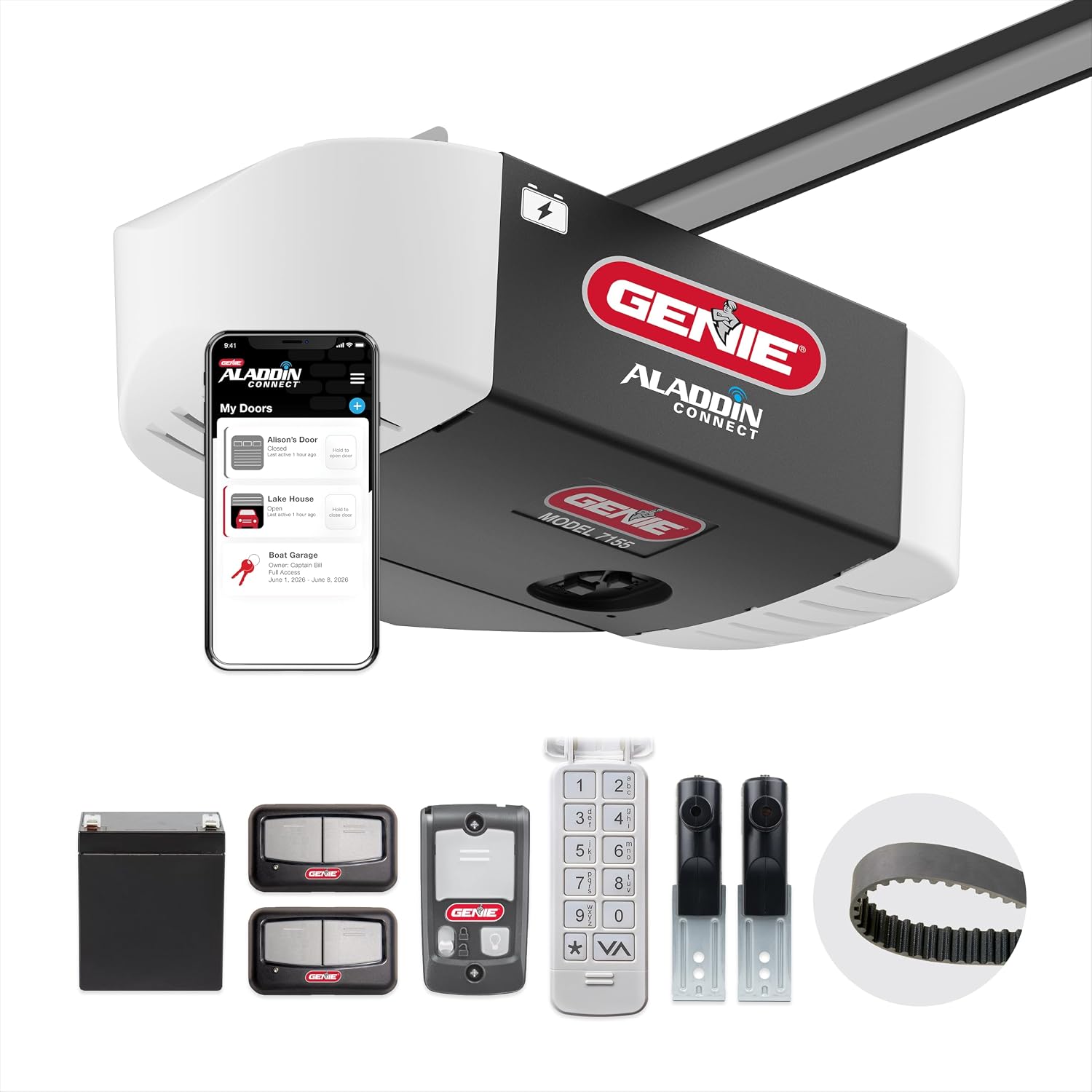
Chamberlain B6765T Smart Garage Door Opener w/Built in HD Camera, Battery Backup & LED Lighting - myQ Smartphone Control - Ultra Quiet, Strong Belt Drive and MAX Lifting Power, Wireless Keypad Inc
Check current Amazon price
Belt drive opener with battery backup, a built-in HD camera, LED lighting, myQ smartphone control, and a wireless keypad included.
Visit on Amazon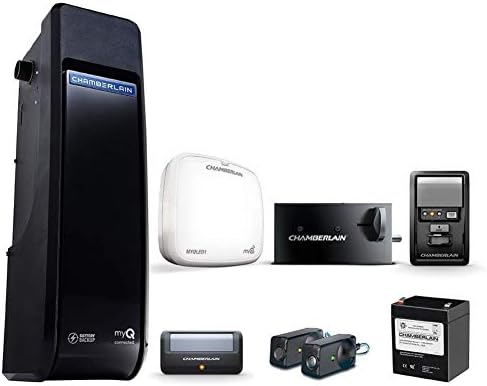
Chamberlain Smart Garage Door Opener - Wall Mounted with Battery Backup - Bright LED Lighting - myQ Smartphone Controlled Ultra Quiet Space Saving Direct Drive, Model RJO70, Black
Check current Amazon price
Wall-mounted direct drive opener with battery backup, bright LED lighting, and myQ smartphone control, built to free up the ceiling.
Visit on Amazon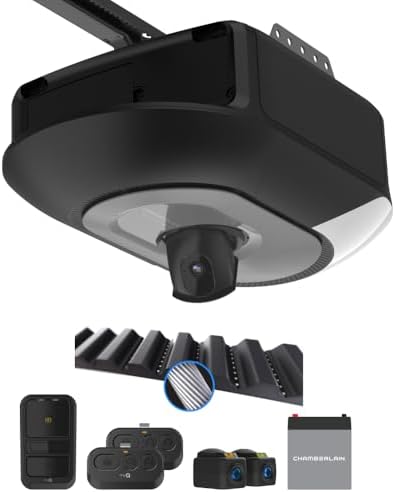
Chamberlain 1 HP Belt Drive Smart Garage Door Opener with Built-in Camera, Single LED Lighting, Battery Backup, and myQ Connectivity
Check current Amazon price
One-horsepower belt drive opener with a built-in camera, single LED light, battery backup, and myQ connectivity.
Visit on Amazon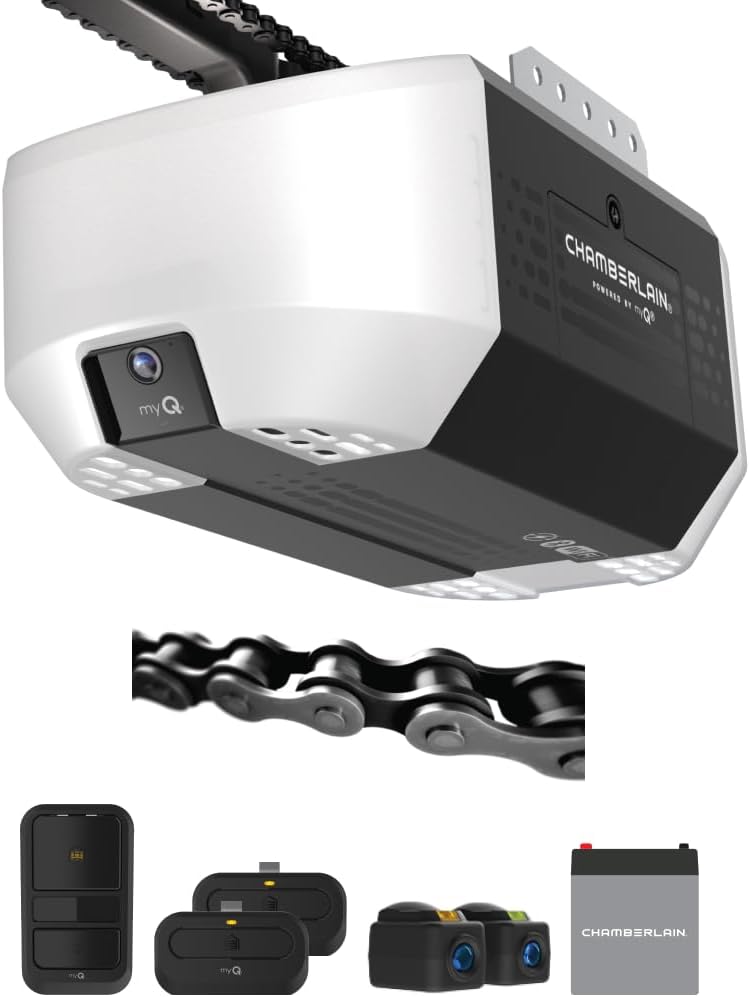
Chamberlain Chain Drive myQ Garage Door Opener, 3/4HP w/Fixed Camera
Three-quarter horsepower chain drive opener with myQ control and a fixed camera.
Visit on Amazon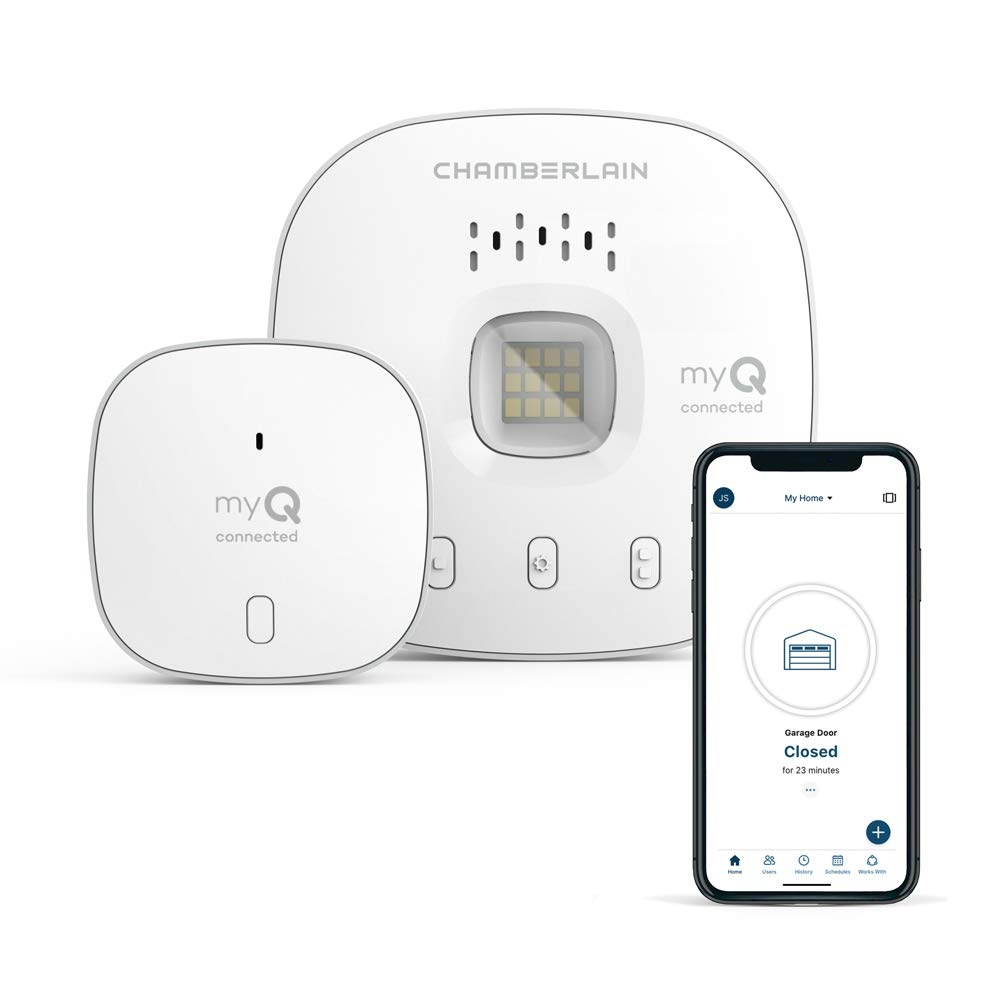
CHAMBERLAIN Smart Garage Control - Wireless Garage Hub and Sensor with Wifi & Bluetooth - Smartphone Controlled, myQ-G0401-ES, White
Wireless hub and sensor that adds Wi-Fi and Bluetooth smartphone control to a compatible opener you already own.
Visit on Amazon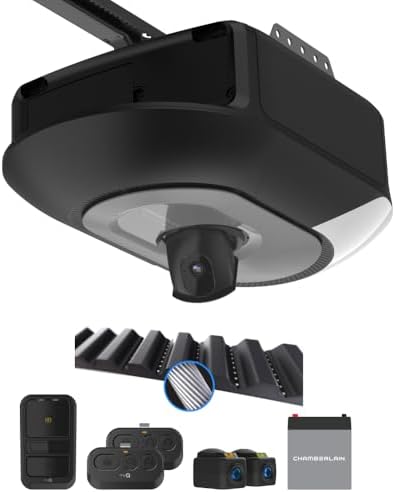
meross Smart Garage Door Opener Remote with External Antenna
Retrofit smart remote with an external antenna for adding app control to an existing garage door opener.
Visit on AmazonPrices and availability may change. Check the retailer for current details.
How these products were compared
This guide compares drive type and noise character, battery backup, camera and lighting, the smart control platform, and whether the product replaces an opener or retrofits an existing one. Those five points are where these six products genuinely differ, and they are the points that decide whether you are happy in year three.
Drive type is the first split. Belt drive units use a steel-reinforced belt instead of a chain, which removes most of the metallic clatter a chain makes as it travels the rail. Direct drive, as on the wall-mounted model here, removes the long rail entirely by turning the motor against the torsion shaft above the door. Chain drive is the traditional layout and still the least expensive way to move a heavy door. Battery backup is the second split: some models here carry it and some do not, which matters most in storm country where the power and the door tend to fail on the same night. Camera and lighting are the third: a built-in camera turns the opener into a garage-facing view you can check from a phone, and LED lighting replaces the single dim bulb most older openers ship with.
The fourth point is the control platform. The Chamberlain units here use myQ for smartphone control, and the retrofit hub also uses myQ, while the meross unit runs on its own app. That difference shows up in how you invite family members, how you check whether the door is open, and which voice assistants you can connect. The fifth point is scope of work: two of these products are complete openers with motors, rails, and hardware, and two are controllers that attach to an opener that already works.
Product names, images, and retailer links are matched by each product's own identifier so that every card points to the product shown. The distinctions below come from the documented drive type, included accessories, and control platform on each listing, not from a measurement bench.
How to choose the right smart garage door opener
Start with the door, not the box. A garage door opener is only as good as the door it lifts, and an unbalanced door will wear out a belt, a chain, and a set of gears regardless of how much you spent. Before you buy anything, disconnect the opener and lift the door by hand. It should move with steady resistance and stay put when you let go at the halfway point. If it slams down or drifts, the springs or the track need attention first, and that is a job for a professional because torsion springs are lethal to work on. A balanced door is also the cheapest performance upgrade you will ever make: a 3/4 horsepower unit on a balanced door outperforms a 1 horsepower unit on a binding one.
Next, decide whether you are replacing or adding. If the existing opener is older than about ten years, noisy, or has already eaten a gear set, replace the whole unit. If it runs quietly and the remotes work, a retrofit controller is a fraction of the cost and an hour of your time. The two hubs here do the same basic job through different apps, and either one gets you phone control, scheduling, and open or closed status without touching the motor. Just check that your opener has the wall-panel or push-button terminals the hub needs, because a few older models do not.
Then pick a drive type. If there is a bedroom above the garage, belt drive is worth the small premium every time, because a belt does not transmit the rumble a chain does through the framing. If the garage is detached or the opener serves a shop, chain drive is fine and usually cheaper. If you have low headroom, a wall-mount direct drive unit solves a problem no ceiling-mounted opener can solve, since it mounts beside the door on the wall.
Finally, match the horsepower to the door. A single-car door with a light steel or wood door is comfortable with a 3/4 horsepower unit. A double-car door, a heavy insulated door, or a door with a lot of glass is better served by 1 horsepower. Overbuying horsepower does not fix a stiff door, and underbuying it means the opener strains every cycle.
Chamberlain B6765T Smart Garage Door Opener w/Built in HD Camera, Battery Backup & LED Lighting - myQ Smartphone Control - Ultra Quiet, Strong Belt Drive and MAX Lifting Power, Wireless Keypad Inc
This is the model that covers the most ground in one purchase. It is a belt drive opener, so it addresses the noise question at the source rather than with insulation. It carries battery backup, which keeps the door working when the grid does not. It has a built-in HD camera and LED lighting, which means you get a view of the garage and better light on the floor without adding separate hardware. It uses myQ for smartphone control, and it includes a wireless keypad, so you do not have to buy the outdoor entry pad as an extra.
The trade-off is that it is a complete opener, not a controller. You are buying a motor, a rail, and a full install, so if your current opener is healthy, this is more product and more work than the job requires. It also commits you to the myQ ecosystem for app control, which is a benefit if the rest of your house is already there and a consideration if you have deliberately avoided cloud-connected hardware. And because it is a ceiling-mounted belt unit, it still needs headroom above the door.
Alternatives to consider
The Chamberlain Smart Garage Door Opener, Wall Mounted RJO70 is better suited to a garage with low headroom or a ceiling you want kept clear, since it mounts on the wall beside the door and uses direct drive instead of a long rail. It keeps battery backup, bright LED lighting, and myQ control, and it is the quiet, space-saving option in this group. The Chamberlain 1 HP Belt Drive Smart Garage Door Opener with Built-in Camera is a stronger fit when the door is heavy or double-wide, since the higher horsepower rating pairs with the same belt drive quietness, a built-in camera, single LED lighting, battery backup, and myQ connectivity.
The Chamberlain Chain Drive myQ Garage Door Opener, 3/4HP w/Fixed Camera, the CHAMBERLAIN Smart Garage Control hub and sensor, and the meross Smart Garage Door Opener Remote with External Antenna cover the rest of the field. The chain drive unit is the traditional layout with myQ control and a fixed camera for a detached garage or a shop where noise does not carry into living space. The Chamberlain hub and the meross remote both retrofit a working opener: the hub adds Wi-Fi and Bluetooth control through myQ, and the meross unit adds app control with an external antenna for garages where the signal has to fight its way through a metal door or a detached wall.
Day-to-day use and maintenance
Once an opener is installed, most of what shortens its life is mechanical, not electronic. Keep the door balanced and the track clean. Wipe the track with a dry cloth and avoid greasing it, since grease collects grit that wears the rollers. Lubricate the rollers, hinges, and the torsion bearings lightly with a garage-door lubricant once or twice a year, and leave the rail on a belt drive alone unless the manufacturer says otherwise. Test the safety reverse monthly by placing a piece of wood in the door's path and closing it: the door should reverse on contact. Then check the photo-eye by blocking the beam with your foot while the door is closing, and adjust the sensors if they have drifted. Sunlight hitting one sensor at the same time every afternoon is the most common cause of a door that refuses to close, and a small cardboard shade fixes it in minutes.
Battery backup deserves its own note. The battery in a backup opener lives in the hottest part of the house, and heat is what kills it. Test it twice a year by killing the breaker to the opener and running the door once on battery power. If the door is sluggish or will not complete a cycle, replace the battery rather than waiting for the next outage to find out. Remotes and keypads have the same problem in a milder form: a remote that lives in a visor in an Oklahoma summer will fail earlier than one kept in the console.
Smart control adds one more maintenance item: the network. If the app stops reporting the door, check the router before you check the opener. Most openers that "forgot" their connection simply lost the Wi-Fi band they were paired to, and re-pairing takes a few minutes. If your opener ever forgets its travel limits after an outage, stop the door, re-run the limit setup per the manual, and check the door balance again before you assume the board is bad.
Buying checklist
- Measure the headroom above the door and the width of the opening, and confirm the rail length suits your door.
- Choose drive type and horsepower based on normal use rather than an occasional edge case.
- Confirm that the exact model includes battery backup if your area loses power often.
- Decide between a full opener and a retrofit controller before you compare prices.
- Verify that the control platform works with the assistants and phones in your house.
- Test the door balance by hand before install day, and call a professional for spring work.
- Verify the current retailer price, availability, and return terms.
Final recommendation
Choose the Chamberlain B6765T Smart Garage Door Opener w/Built in HD Camera, Battery Backup & LED Lighting - myQ Smartphone Control - Ultra Quiet, Strong Belt Drive and MAX Lifting Power, Wireless Keypad Inc when you want one purchase to cover a quiet belt drive, battery backup, a camera, lighting, myQ control, and a keypad, especially with a bedroom above the garage. Choose the Chamberlain Smart Garage Door Opener, Wall Mounted RJO70 when headroom is tight or you want the opener off the ceiling, and step up to the 1 HP belt drive model when the door is heavy. Choose the Chamberlain Chain Drive myQ Garage Door Opener, 3/4HP w/Fixed Camera for a detached garage or shop where chain noise does not matter, and choose the CHAMBERLAIN Smart Garage Control or the meross Smart Garage Door Opener Remote with External Antenna when your existing opener is healthy and you only want phone control. If your door is out of balance or the springs are tired, fix that first, because no opener on this list will last behind a door that fights it.